

Alright, fellow running nerds, we need to talk about the absolute game-changer that just dropped in the running world. The Adidas Adizero Adios Pro Evo 3 has completely flipped the script on what we thought was possible in marathon racing shoes. I’ve been geeking out over this release for weeks now, and after diving deep into the specs and watching what went down in London, I’m absolutely blown away.
The Sub-2-Hour Barrier Smasher
So unless you’ve been living under a rock (or, you know, actually having a life outside of obsessively tracking running shoe releases like yours truly), you probably heard that Sabastian Sawe just crushed the London Marathon with an official sub-2-hour time of 1:59:30. And guess what was on his feet? Yep, the Adizero Adios Pro Evo 3.
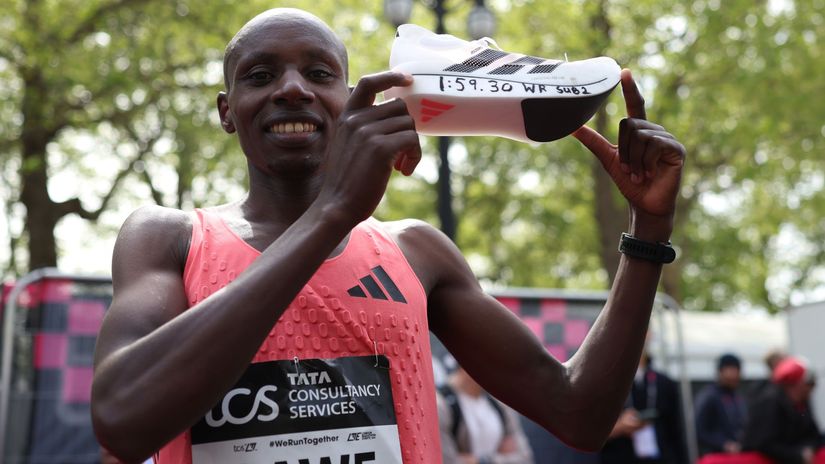
Look, I’ve tested dozens of carbon-plated racers over the years, but this one is different. Like, seriously different. We’re talking about a shoe that weighs just 96-97 grams (that’s about 3.4 ounces for my American friends). For perspective, that’s roughly HALF the weight of most elite racing shoes on the market. My trusty kitchen scale nearly broke trying to register something this light!
Three Years in the Making
What’s crazy is that this wasn’t some overnight development. Adidas reportedly spent THREE WHOLE YEARS perfecting this design. While Nike was making headlines with their Breaking2 project and the whole Kipchoge spectacle (which, don’t get me wrong, was incredible), Adidas was quietly grinding away in the lab.
The result? A shoe that doesn’t just shave seconds off your time—it potentially shaves MINUTES. According to research cited in the Wall Street Journal, dropping about 100 grams from a running shoe can save roughly 57 seconds over a marathon distance. And wouldn’t you know it, Sawe beat the third-place finisher by 58 seconds. Coincidence? I think not!
What Makes the Evo 3 So Special?
Let’s break down what makes this featherweight monster tick:
- Weight: 96-97 grams. That’s lighter than some energy gels I carry on my runs!
- Construction: Instead of a full carbon plate, it uses a carbon fiber rim design that somehow still delivers insane energy return
- Foam: Ultra-responsive Lightstrike Pro foam that’s been completely redesigned for maximum spring and minimum weight
- Durability: And here’s the kicker—it’s designed for ONE race. Yep, you read that right. This is basically the F1 car of running shoes.
I’ve literally spent hours poring over the technical details, and I’m still amazed at how they managed to cut so much weight without sacrificing performance. It’s like they threw the running shoe rulebook out the window and started from scratch.
The Price Tag and Availability Drama
Now, let’s address the elephant in the room—the price. At $500 retail, this is not your casual weekend 5K shoe. This is an investment that makes my credit card sweat just thinking about it. And that’s IF you can even get your hands on a pair!
The initial release sold out in literal minutes. Now, if you check resale sites like StockX, these babies are going for upwards of $2,000 (and some sizes are hitting $4,000)! That’s straight-up bonkers. I love running shoes more than most people love their pets, but even I can’t justify dropping two grand on a pair of shoes I’ll wear once.

How Does It Compare to Other Super Shoes?
Since most of us won’t be rocking the Evo 3 anytime soon (unless we win the lottery or sell a kidney), let’s talk about how it stacks up against other elite racing options:
Evo 3 vs. Nike Alphafly 3
The Alphafly 3 was the previous king of the hill, used for the previous marathon world record. It weighs around 8.8 oz (250g), which now seems positively chunky compared to the Evo 3. The Alphafly offers more cushioning and comfort, which might actually make it a better choice for us mere mortals who aren’t trying to break world records but just want to PR at our local marathon.
Price-wise, the Alphafly 3 retails for $295, and you can often find it on sale for around $215. That’s still expensive, but it won’t require a second mortgage.
Evo 3 vs. Asics Metaspeed Ray
The Metaspeed Ray is probably the closest competitor in terms of feel, according to runners who’ve tried both. It’s super light at around 4.8 oz (136g) and has that same bouncy, responsive ride. At $300, it’s still a premium shoe but significantly more affordable than the Evo 3.
I’ve personally logged some of my best times in the Metaspeed Ray, including a half marathon PR that I’m still bragging about to anyone who’ll listen (sorry not sorry).
Evo 3 vs. Puma Fast-R Nitro Elite 3
The Fast-R 3 has been making waves with its distinctive design featuring an extended carbon plate. It’s not as light as the Evo 3, but at $300, it offers elite-level performance at a (relatively) more accessible price point. Plus, that Poison Pink colorway is straight fire—sometimes looking fast is half the battle, right?
Is the Adios Pro Evo 3 Worth It?
Here’s my honest take: For 99.9% of runners, including serious amateurs like myself who obsess over every second of their marathon time, the Evo 3 is more shoe than we need. It’s designed for the absolute elite—the top 0.1% who are pushing the boundaries of human performance.
Plus, there’s the whole one-race lifespan thing. Adidas themselves admit this shoe is designed for a single marathon. For $500, that’s $19 per mile! My car gets better value than that, and it’s a total beater.
That said, I can’t help but admire what Adidas has accomplished here. They’ve created a true unicorn in the running world—a shoe so specialized, so purpose-built, that it helped shatter what many considered an impossible barrier. It’s like the running equivalent of breaking the sound barrier or reaching the summit of Everest for the first time.
The Bigger Picture: What This Means for Running
The development of the Evo 3 signals something bigger happening in the running shoe industry. While Nike dominated the carbon-plate revolution early on, we’re now seeing a more competitive landscape with Adidas, Asics, Puma, and others pushing each other to new heights.
This competition is good for the sport. It drives innovation, pushes boundaries, and ultimately trickles down to benefit everyday runners like us. The technology that makes the Evo 3 possible today will influence more accessible shoes tomorrow.
It’s also worth noting how Adidas approached this launch differently than Nike did with Breaking2. Instead of creating a controlled, non-record-eligible event, they put their technology to the test in an official race setting. They even reportedly contributed about $50,000 to enhanced anti-doping measures, with Sawe being tested 25 times in just two months leading up to the Berlin Marathon. That’s some serious commitment to credibility.
Final Thoughts: Revolution or Hype?
After spending way too many hours researching and obsessing over the Adizero Adios Pro Evo 3 (my girlfriend is seriously questioning our relationship at this point), I’ve come to this conclusion: It’s both revolutionary AND overhyped.
Revolutionary because it genuinely represents a quantum leap in running shoe design and has proven its worth at the highest level of competition. The sub-2-hour marathon is no longer theoretical—it’s an official reality.
Overhyped because the resale market has gone absolutely nuts, and the practical benefits for 99% of runners don’t justify the astronomical price tag.
Would I buy a pair if I could get them at retail price? In a heartbeat. Would I wear them for my next marathon? Probably not—I’d be too afraid of wasting their one-race lifespan on my decidedly non-elite performance. I’d probably just display them in a glass case and stare at them lovingly while wearing my trusty Asics for actual running.
What do you think? Is the Adizero Adios Pro Evo 3 the future of running, or just an expensive novelty? Drop your thoughts in the comments—I’m dying to hear what other shoe geeks think about this game-changer!
Until next time, keep logging those miles and obsessing over shoe specs. It’s what makes us runners the special brand of crazy that we are.